


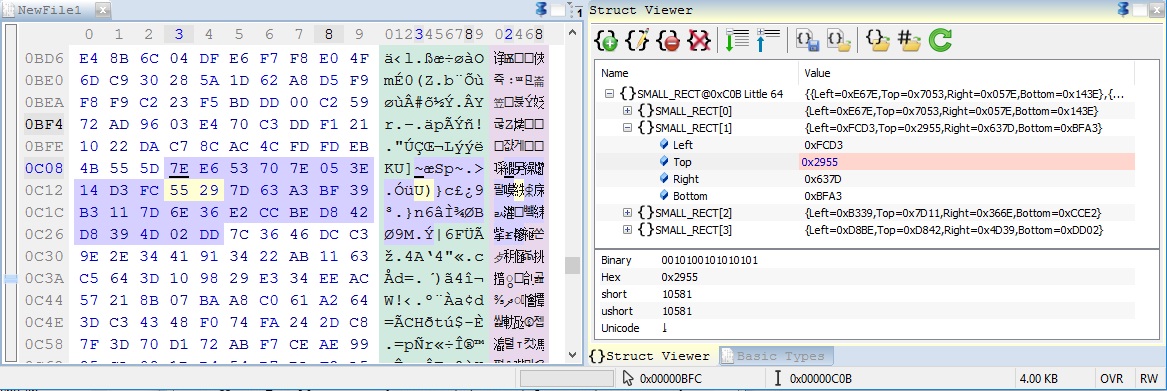
|
Add Structure |
|
Edit Structure Properties |
|
Remove Selected Structure(s) |
|
Remove All Structures |
|
Expand All Structures |
|
Collapse All Structures |
|
Save Structures List: save current strutures list into a file for future reloading |
|
Reload Structures List: reload a saved list of structures |
|
Open Structures Folder |
|
Open Defines Folder |
|
Reload Structures And Defines Definitions |

 |
Specific cases :
As file name can't have ":", "<" or ">" symbols, user type file name must follow the following replacement rules - for "Class::Type" type, a "Class..Type.txt" file will be searched ( ":" replaced by ".") - for "TemplateType<MyType>", "TemplateType(MyType).txt" file will be searched ( "<" replaced by "(" and ">" by ")") Notice : You still can let "Class::Type" or "TemplateType<MyType>" type in your definitions content, the translation is done by Helium Hex Editor. Only text file name needs to be affected |
#include : Include other user type files with #include
    #pragma pack(push)
    #pragma pack(1)
    typedef struct
    {
        BYTE b;
        WORD w;
        DWORD dw;
    }STRUCT1;
    #pragma pack(pop)
        struct __tagVARIANT
        {
            #pragma next_field_define_values_file("VARTYPE_Defines.txt")
            VARTYPE vt;
            WORD wReserved1;
            WORD wReserved2;
            WORD wReserved3;
            ...
        }
when decoding something like VT_UI4 will displayed instead of 19
        #pragma next_enum_size(1)
        typedef enum
        {
            E1_value0=0,
            E1_value1,
            E1_value2,
        }ENUM1;

        #pragma next_enum_size(2)
        typedef enum
        {
            E2_value0=0,
            E2_value1,
            E2_value2,
        }ENUM2;
        typedef struct
        {
            WORD w; // w will be parsed as little endian (default)

            #pragma next_field_endianness(big_endian)
            DWORD dw; // dw will be parsed as a big endian
            STRUCT2 Struct2;
        }STRUCT1;
        #pragma next_struct_endianness(big_endian,true)
        typedef struct
        {
            WORD w;   // w will be parsed as a big endian
            DWORD dw; // dw will be parsed as a big endian
            STRUCT2 Struct2; // in this case, Struct2 will be parsed as a big endian struct as endianness applies to substructures
        }STRUCT1;
        All the fields and nested structs of the previous struct will be parsed as big endian

        #pragma next_struct_endianness(big_endian,false)
        typedef struct
        {
            WORD w;   // w will be parsed as a big endian
            DWORD dw; // dw will be parsed as a big endian
            STRUCT2 Struct2; // in this case, Struct2 will be parsed as a little endian struct as endianness doesn't apply to substructures
        }STRUCT3;
        typedef struct
        {
            WORD w;

            #pragma next_field_must_match(2)
            DWORD dw;

            STRUCT2 Struct2;
        }STRUCT1;
The background color of dw is green if dw==2, red else.
        typedef struct
        {
            ...
            #pragma next_field_must_match(2)
            DWORD dw;

            #pragma next_field_must_match("Some String")
            LPCSTR String;

            #pragma next_field_must_match("Some String")
            LPWCSTR wString;

            #pragma next_field_must_match({00000000-0000-0000-C000-000000000046})
            GUID gGuid;
        };
        typedef struct
        {
            ...
            #pragma next_field_must_match_one_of(1,8,64,128,256,512,1024,2048)
            DWORD dw;

            #pragma next_field_must_match_one_of("AnsiString1","AnsiString2","AnsiString3")
            CHAR String[256];

            #pragma next_field_must_match_one_of("UnicodeString1","UnicodeString2","UnicodeString3")
            WCHAR wString[256];

            #pragma next_field_must_match_one_of({00000000-0000-0000-C000-000000000046},{00021401-0000-0000-C000-000000000046},{04731B67-D933-450a-90E6-4ACD2E9408FE})
            GUID gGuid;
        };
        typedef struct
        {
            ...

            // for the following field, the full buffer content will be compared
            #pragma next_field_must_match_buffer({0x11,0x22,0x33,0x44,0x55})
            BYTE Array1[5];

            // for the following field, only buffer begin will be compared
            #pragma next_field_must_match_buffer({0x11,0x22,0x33,0x44,0x55})
            BYTE Array2[12];

            ...
        };
        typedef struct
        {
            ...

            // for the following field, the full buffer content will be compared
            #pragma next_field_must_match_one_of_buffer({0x11,0x22,0x33,0x44,0x55},{0x51,0x42,0x33,0x24,0x15},{0x21,0x32,0x43,0x54,0x65})
            BYTE Array1[5];

            // for the following field, only buffer begin will be compared
            #pragma next_field_must_match_one_of_buffer({0x11,0x22,0x33,0x44,0x55},{0x51,0x42,0x33,0x24,0x15},{0x21,0x32,0x43,0x54,0x65})
            BYTE Array2[12];

            ...
        };
        typedef struct
        {
            ...
            #pragma next_field_must_be_less_or_equal(80)
            DWORD dw;

            #pragma next_field_must_be_less_or_equal(0x28)
            DWORD dw2;
            ...
        };
        typedef struct
        {
            ...
            #pragma next_field_must_be_greater_or_equal(3)
            DWORD dw;

            #pragma next_field_must_be_greater_or_equal(0x28)
            DWORD dw2;
            ...
        };
        typedef struct
        {
            ...
            #pragma next_field_must_be_between_inclusive(10,56)
            DWORD dw;

            #pragma next_field_must_be_between_inclusive(2.7,2.95)
            double dbl;

            #pragma next_field_must_be_between_inclusive(2.5,4.5)
            float f;
            ...
        };
User Defines |
Only integer defines are supported (no floats or strings support) |